
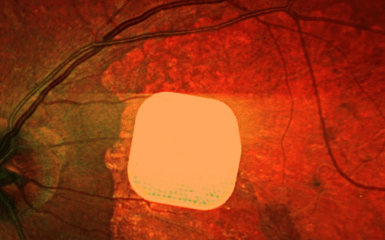
In 17 clinics in Europe, ophthalmologists tested the ultra-thin Prima electronic implant. It gave people with age-related macular degeneration partial vision restoration.
Points of attention
- Specialized training and intensive rehabilitation are essential for patients to effectively utilize this type of vision provided by the Prima implant.
- According to experts, the Prima implant requires patients to adapt to the technology, highlighting the importance of patient education and support post-activation.
What is known about the Prima implant?
According to the developers, it is a microchip only half the thickness of a human hair and 2×2 millimeters in size.
It is surgically placed under the retina of the eye. During the operation, which lasts about 2 hours, the patient is fitted with a device that then works in conjunction with augmented reality glasses.
The glasses are equipped with a video camera and a minicomputer on the belt. The camera reads the image, converts it into an infrared signal and transmits it to a microchip, which activates retinal cells. The information then travels through the optic nerve to the brain, forming an image.
What is important to understand is that 84% of the test participants regained their ability to read.
Each of them suffered from the "dry" form of age-related macular degeneration, the leading cause of vision loss among people over 50, which is incurable.
It is also indicated that the trial participants underwent special training and intensive rehabilitation.
"It doesn't work like you put a chip in your eye and you can see right away. You have to learn to use that type of vision," Mahi Mukit, a senior consultant ophthalmologist at Moorfields Hospital in London, told reporters.

