
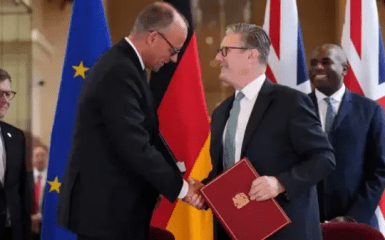
Germany and the United Kingdom signed in London the Treaty of Friendship and Bilateral Cooperation between the Federal Republic of Germany and the United Kingdom of Great Britain and Northern Ireland.
Points of attention
- The Treaty of Friendship and Cooperation signed between Germany and Britain is a historic milestone for both countries, covering areas such as security, defense, trade, and economics.
- The agreement emphasizes close cooperation in weapons projects, mutual military assistance, and deepening collaboration between intelligence services to address new security challenges.
- Although the German-British treaty does not include specific clauses on nuclear deterrence, both sides plan to coordinate efforts to address threats to NATO's northern and eastern flanks, with a focus on countering aggression by the Russian Federation.
Germany and Britain signed a Treaty of Friendship and Cooperation
The documents were signed by the heads of government of Germany, Friedrich Merz, and Great Britain, Keir Starmer, as well as the foreign ministers of Germany, Johann Wadeful, and Great Britain, David Lammy.
Starmer called the signing a "historic" fact, and the document a "very special agreement, the first of its kind ever between the two countries." It covers, according to the British Prime Minister, such areas as security, defense, trade, the economy, etc.
This is a historic day for German-British relations.

Friedrich Merz
Chancellor of Germany
He noted that this will deepen cooperation, especially after the UK leaves the EU.
We will cooperate more closely in the areas of defense, foreign policy, and economic policy.
The treaty focuses primarily on security policy: the two states agreed on closer cooperation in weapons projects, mutual military assistance, deepening cooperation between intelligence services, etc.
Both sides commit to jointly addressing “new, far-reaching challenges to Euro-Atlantic security in an era characterized by heightened strategic competition, challenges to the rules-based international order, and challenges to their democracies from growing hybrid threats.”
The German-British treaty does not contain specific clauses on nuclear deterrence, however, it mentions conducting an in-depth dialogue on defense issues of common interest and global strategic foresight, including nuclear issues.
The document mentions a war of aggression by the Russian Federation, which is identified as the “most significant and immediate threat” to security. Both sides plan to coordinate their efforts to deter and ensure the security of NATO’s northern and eastern flanks.


