
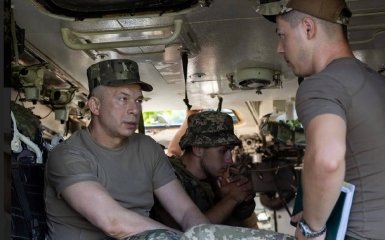
On February 8, 2024, Oleksandr Syrsky was appointed Commander-in-Chief of the Armed Forces of Ukraine. A year later, he outlined his priorities while serving in the country's highest military position.
Points of attention
- Oleksandr Syrsky, serving as the Commander-in-Chief of the AFU, emphasized priorities such as the destruction of enemy facilities, modernization of the armed forces, and saving lives of military personnel.
- Under Syrsky's leadership, the AFU has focused on measures to counter enemy aggression, including the use of drones and electronic warfare to enhance combat effectiveness.
- Significant achievements include reducing the ratio of Russian artillery ammunition, increasing drone strikes, improving soldier training, and targeting military facilities in the enemy's territory.
- Syrsky's emphasis on unity within the Ukrainian Armed Forces as a pillar of stability and victory highlights the importance of standing together against external threats.
- Efforts towards capacity building, adoption of NATO standards, and restructuring military units showcase the commitment to strengthening the AFU's combat potential for continued defense and resilience.
A year at the head of the AFU — Syrsky on his priorities
The military leadership of the Armed Forces was renewed, new commanders were appointed. During the year, my deputies, the General Staff team, commanders and our soldiers and sailors, sergeants and foremen, officers and generals have been with me in the ranks,” Syrsky noted.
The Commander-in-Chief of the Armed Forces of Ukraine emphasized that all the Defense Forces of Ukraine together defend the Motherland from the enemy.
Together we defend Ukraine. Together we stopped the enemy's offensive in the Kharkiv region, prevented the offensive in the Sumy region and transferred the war to the enemy's territory. Together we restrain the ongoing offensive of the aggressor in the east. Together, during the year, we destroyed more enemy manpower, military equipment and military facilities than in the previous years of the war combined. I thank each and every one who is loyally and courageously fighting for our Motherland. It is an honor for me to be in the same ranks with you.

Oleksandr Syrsky
Commander-in-Chief of the Armed Forces of Ukraine
Syrsky recalled that a year ago, the heavy defense of Avdiivka was ongoing, our units were semi-encircled. One of his first decisions as Commander-in-Chief was to order an organized withdrawal from the city, which had been destroyed by artillery and anti-aircraft guns.
This is our key priority: saving people's lives.
We are fighting for our land, but the life of a Ukrainian soldier is the most important. Therefore, the Armed Forces have developed and are implementing a comprehensive program “Saving the lives of servicemen”. The key areas of the program are: technologization of the army, improving the training of Ukrainian defenders, improving the provision of medical care at all stages. An important aspect of the program’s implementation is the actions of unit commanders, because they bear the maximum responsibility for saving the lives of personnel.
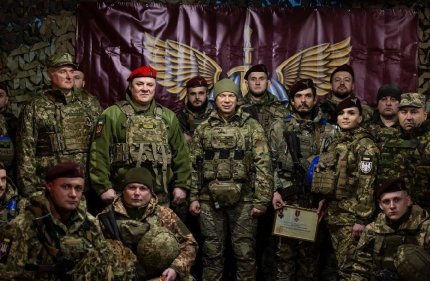
Priority 2: hit from a distance.
During 2024, the state deployed more than 1.3 million drones to the front. We were the first in the world to create the Forces of Unmanned Systems, scaled up the already existing legendary units “Birds of the Magyar”, “Achilles”, “K-2” and others. We are developing the areas of robotic platforms, land and sea drones. The enemy fully feels the power of our FPV drones. Over the year, the number of targets hit by strike UAVs of various types exceeded 461 thousand.
A year ago, the advantage of Russian troops in artillery ammunition was approximately 1:10. Today, this ratio has decreased to almost 1:2.
I thank the partner countries for supplying ammunition. I express my gratitude to the domestic gunsmiths who are increasing production and strengthening the front with weapons and military equipment marked "made in Ukraine."
This was also made possible by our targeted destruction of Russian artillery. Over the year, we destroyed about 13,050 enemy artillery systems (8,400 in the previous two years). Successful counter-battery combat, together with the work of drones, is ending the dominance of Russian guns on the battlefield.
Priority 3: To win, prepare.
Despite the constant pressure of the aggressor on the battlefield, we are making every effort to improve the training of Ukrainian servicemen. The duration of basic general military training (BGMT) has been increased to 1.5 months. This has made it possible to expand the training program and include the necessary modern elements, in particular electronic warfare and UAVs. We are considering the possibility of extending basic training to 2 months. We are strengthening the training of instructors. We conducted a successful experiment on conducting BGMT in the rear bases of combat brigades. In addition, I insist on providing a 14-day adaptation course in military units after BGMT even before combat work. The more prepared and psychologically stable a soldier is, the stronger our positions will be at the front.
This year, for the first time, training on foreign weapons and military equipment is being carried out not abroad, but in Ukraine, which significantly optimizes costs and time. This was made possible by increasing the number of instructors trained abroad.
The share of sergeants and key specialists trained in Ukraine — snipers, sappers, and combat medics — has also increased relative to that trained abroad.
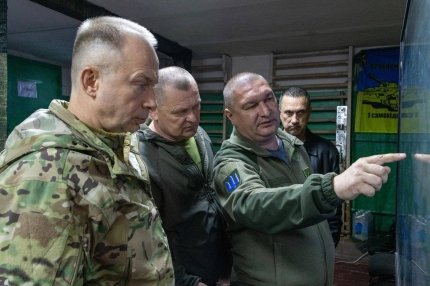
Priority 4: Russia is on fire.
The escalation of attacks on military facilities in enemy territory continues. Military units, arsenals, storage facilities, workshops of military-industrial complex enterprises, oil refineries that supply fuel to the Russian army, and other facilities will be attacked as long as Moscow's aggression against our state continues.
The range of DeepStrike strikes deep into the territory of the Russian Federation has already reached 1.7 thousand km. We are preparing new long-range weapons, and they will be used.
This year, 377 military facilities were targeted for successful comprehensive fire destruction on the territory of the Russian Federation.
The Air Force and other components of the defense forces destroyed 9,200 air targets of various types during the year, which is 2.4 times more than in 2023 (3,798).
Priority 5: unconventional actions. Not just defense.
Ukraine is capable of counterattacking, beating and driving the enemy. This was proven by the defense of Kyiv, the Kharkiv offensive operation, the liberation of the right-bank Kherson region. This was also demonstrated by the Kursk operation. We created a buffer zone in the Kursk region, destroying the enemy's plan to launch a new offensive on Sumy and Kharkiv. This operation also eased the pressure on some sections of the front.
During 6 months of active hostilities on the territory of the Russian Federation, the total losses of Russian troops in manpower amounted to more than 47 thousand people, of which more than 19 thousand were killed. Moreover, these are the most trained Russian troops. A group of North Korean mercenaries was also defeated.
During the operation, 924 Russian military personnel were captured. The replenishment of the exchange fund made it possible to free some of our servicemen, including those who had been in captivity since the spring of 2022.
The creation of new mechanized brigades helped attract fresh units to the Kursk Offensive. Thanks to this, we were able to withdraw three brigades of the Airborne Assault Forces from the Donetsk region to restore combat readiness, to replenish and re-equip them, which yielded results: we have been holding hundreds of square kilometers of the aggressor country's territory for over 6 months.
Priority 6: Change to win.
A year ago, we began work on auditing military units and military command bodies, in particular the General Staff. As a result of the audit, a number of military structures and institutions were disbanded or reduced, which allowed us to eliminate duplication of functions, remove inappropriate functions, and reduce unjustifiably inflated staff numbers. The General Staff has become an effective military command body.
Through the released personnel, we have replenished the operational and tactical management bodies and combat military units. About 70 thousand servicemen have been sent to the combat zone as a result of the reduction (reduction) of the number of security, service and support units.
We have introduced a system of promotion and appointment of officers in military command bodies subject to the participation (availability of experience) of servicemen in combat operations during the repulse of the large-scale invasion of the Russian Federation. We have reduced the intermediate levels of command and formed new military command bodies.
The personnel of the General Staff and the Commander-in-Chief's Office were strengthened with experienced combat generals and officers. The command structure of formations and units was significantly updated. The main criterion for appointment to positions is the ability to effectively perform combat missions while preserving the life and health of subordinates.
This year, the Armed Forces of Ukraine have fully transitioned to NATO standards and principles in the training and management of troops.
Priority 7: Capacity building.
During the year, the Armed Forces increased their combat potential, which allowed us to prevent the enemy from breaking through and restrain its offensive, despite the increase in the number of enemy troops by another 140 thousand people.
We created assault units (companies, battalions), which showed their effectiveness during active combat operations (offensives), including in the Kursk region. Today, we are forming assault regiments on their basis.
We have also managed to significantly increase the capabilities of the Armed Forces to combat in the electromagnetic spectrum. An additional electronic warfare battalion has been formed, over a hundred electronic warfare companies in brigades, and electronic warfare detachments in line battalions of brigades.
The formation of a separate training center for electronic warfare specialists has begun. The Iceberg electronic warfare management system has been developed and implemented in the troops. 83 new electronic warfare devices have been codified and tens of thousands of devices have been delivered to the troops. The capabilities of the Pokrova electronic warfare subsystem have been increased.
We have increased our fighter air cover capabilities by deploying F-16 aircraft. We are also strengthening our air defense with Mirage 2000 multi-role fighters, which have already been provided by our French partners.
We improved the counteraction and destruction of UAVs by involving combined aircraft and helicopter detachments, and UAV interceptor crews. We strengthened the counteraction to guided aerial bombs and the destruction of UAVs by additional deployment of modern hardware and software complexes and electronic warfare means.
Direct coverage of priority critical infrastructure facilities of the fuel and energy sector and industry was carried out.
We ensured the prohibition of the actions of enemy surface forces in the western part of the Black Sea, thereby creating conditions for the launch of a sea corridor and exports from/to the ports of Ukraine.
They forced the Russian Black Sea Fleet to withdraw virtually all warships, including the Caliber carriers, from Sevastopol and Feodosia to Novorossiysk.
The experience of three years of combat operations against superior enemy forces dictates the need for changes in the formation of groups and the structure of troops to a more stable and manageable one. We see and understand this. Therefore, these changes will soon take place. In particular, the transition to the corps system initiated by me.
We conducted a thorough analysis of the effectiveness of the existing management system of the Armed Forces of Ukraine. Based on its results, the NSDC decided to put into effect the Concept of Reorganization of the Armed Forces in Wartime, developed by us with the aim of maximizing the combat potential of the Armed Forces of Ukraine.
We have practically already begun to form army corps as the first step towards improving our army.
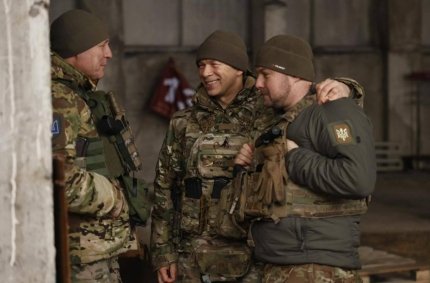
Despite the fact that the reform has to be implemented on the march, we are consistently and confidently moving along this path. In the future, we will build a clear corps structure.
At the end of the third year of a large-scale war, we continue the struggle, no matter how difficult it is. We are streamlining mobilization, intensifying recruitment. At the same time, in the current conditions, we cannot do without the transfer and secondment of servicemen from non-combat military units to combat ones. This process is currently ongoing. After all, if the front, as they say, “falls over,” then all our plans will not be worth a penny.
Priority 8: Unity is the key to our resilience.
I have spent this year with our soldiers. I regularly meet with them on the front lines, hear their suggestions and wishes, and work with them at control points on new solutions for the front.
I know they are tired. For many, this war has been going on for almost 11 years. The last three years have been without rest, in constant struggle. Are there problems? Yes, there are. But we are aware of these challenges and are doing everything we can to overcome them.
History proves: Ukraine will exist as long as its Armed Forces exist. And the Armed Forces will fight as long as the Ukrainian people stand shoulder to shoulder with them. Let us remember that unity is what helped us survive in 2022 and what should lead us to victory now. I see this as my mission and I am fulfilling it.
And finally, but about the main thing.
When you see a tired Ukrainian soldier who has come from the front for a few days to see his family, go up and thank him. Because we are all family. Because this soldier is the only one standing between you and the ruthless Russian invader. Glory to Ukraine!


