
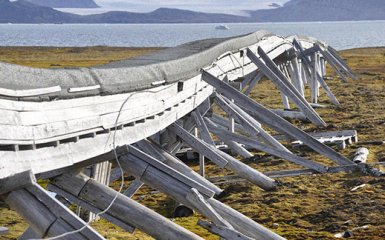
Over the past 30 years, the depth of seasonal thawing of the upper part of permafrost (PM) in Russia has increased from 45 to 70 cm, as a result of which 1,260 km of main gas pipelines and thousands of kilometers of highways are at risk.
Points of attention
- The depth of seasonal thawing of permafrost in Russia has increased significantly over the past 30 years, posing risks to critical infrastructure such as gas pipelines and highways.
- Permafrost covers 65% of Russia's territory and plays a crucial role in the economy, with key regions for oil, gas, and mineral extraction being affected by the destructive effects.
- The shortsightedness of Soviet and Russian engineers in designing infrastructure solely based on permafrost has resulted in annual seasonal destruction of structures, impacting cities like Vorkuta, Norilsk, Yakutsk, and Magadan.
Permafrost is destroying the Russian economy
This is happening in regions that are critically important for the Russian economy, where the main centers of oil, gas, and other mineral extraction are located.
In total, permafrost covers 65% of the territory of Russia, and its zone includes large cities: Vorkuta, Norilsk, Yakutsk, and Magadan.
It is the Russian Arctic regions with permafrost that account for more than half of the entire Arctic territory, and it is there that 10% of Russia's GDP and 20% of its exports are generated, 18% of oil, 90% of natural gas, 90% of nickel and cobalt, 60% of copper, and 100% of diamonds are extracted.
The shortsightedness of Soviet and Russian engineers and builders in designing infrastructure solely based on permafrost led to annual seasonal destruction of structures — almost all Arctic housing (81%) was built here between 1960 and 1999.
More than 40% of buildings in the VM zone are already deformed:
in Vorkuta — 80%,
Magadan — 55%,
Dixon — 35%,
Tiksi — 22%,
Yakutsk and Norilsk — 9–10% each.
At the same time, 1,260 km of main gas pipelines and thousands of kilometers of highways are at risk.
By 2050, the population of the territories of the VM in Russia will decrease by 61% compared to 2017 and will amount to 1.7 million people.


