
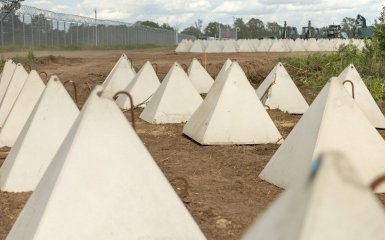
The barriers are arranged in three rows, about ten meters wide, and are designed to prevent military equipment from crossing the border. Each "tooth" weighs about one and a half tons. As the military noted, the gaps between the elements are so small that no armored vehicle will be able to pass through them.
Points of attention
- Latvia is enhancing its security measures by installing “dragon's teeth” barriers along the border with Russia to prevent military equipment from crossing.
- The barriers are strategically placed in three rows with gaps too small for armored vehicles to pass through, ensuring maximum protection.
Latvia prepares for Russian ground invasion
The Latvian National Armed Forces have begun installing the first anti-mobility barriers — the so-called "dragon's teeth" — along the border with Russia.
Preparatory work — construction and manufacturing of barriers — began back in 2024. However, physical installation on state and municipal lands started only in 2025.
The process was held back by several factors: construction of border infrastructure, coordination with the State Border Guard, and logistics of facility placement.
One of the main obstacles reported was the issue of private property — much of the infrastructure is being built on private land. A special law has been enacted to address this issue.
According to Andris Rieksts, the officer responsible for the project, the defensive line should not just contain the enemy, but also stop and destroy him directly at the border — and it is Ukraine's experience that makes this approach principled.
If something does happen, we must be ready to destroy them (Russians, — ed.) here, because we see from the example of Ukraine: once we give up territory, it is practically impossible to return it.
In addition to the "dragon's teeth", the construction of anti-tank ditches is planned in the future. It is being built jointly by Latvia, Lithuania and Poland. They plan to finish it by 2028.
It is worth noting that the total length of Latvia's border with Russia and Belarus is about 450 kilometers.


