
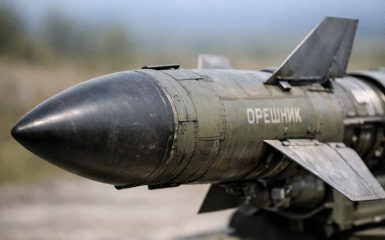
On June 12, the Air Force of the Armed Forces of Ukraine warned that there was a high probability of Russia using a medium-range ballistic missile in the coming days.
Points of attention
- It is crucial to heed air alert signals and remain vigilant amid the possibility of Russia launching 'Oreshnik' missiles towards Ukraine.
- Understanding the capabilities and recent activities related to 'Oreshnik' sheds light on the escalating tensions and potential risks in the region.
Russia is again going to attack Ukraine with “Oreshnik”
During the day, there is a high probability that the enemy will use a medium-range ballistic missile from the Kapustin Yar test site. Do not ignore air alert signals! — says the official statement of the Air Force of the Armed Forces of Ukraine.
What is important to understand is that we are talking about the "Oreshnik" — a medium-range ballistic missile (MRBM), which Western intelligence identifies as the RS-26 "Rubizh".
Russian dictator Vladimir Putin announced it during a speech on November 21, 2024, after the attack on the Dnieper. He cynically called it a test of a new weapons system.
Foreign experts estimate the range of the Oreshnik at 2,000-6,000 km, depending on the configuration of the warheads.
Moreover, it is indicated that its speed in the final section reaches hypersonic values — over Mach 10 or 3+ km/second (11,000+ km/h).
The length of the rocket is about 12 meters, the diameter is about 2 meters, and the launch weight is estimated at 36-40 tons.
On May 24, 2026, the Russian Ministry of Defense officially confirmed that it had used several Oreshnik ballistic missiles for a massive attack on Ukraine.
One of them reached Bila Tserkva, in the Kyiv region, and hit a garage cooperative — without casualties.
According to insiders, the second Oreshnik could have fallen near occupied Avdiivka or Yasynuvata — approximately 40 kilometers from the front line.


