
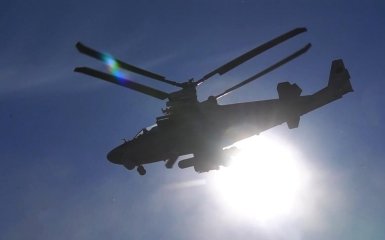
News is spreading in Russian Telegram channels that the Russian army has lost another helicopter. According to preliminary data, it is a Ka-52 - in fact, the second Alligator destroyed in just one day.
Points of attention
- Russian industry's promises to address the drone threat remain unfulfilled, leaving the army vulnerable to continued losses.
- The lack of electromagnetic compatibility poses a critical issue in retrofitting helicopters with effective electronic warfare systems to counter drone attacks.
Russia continues to lose its aircraft at an abnormal rate
The Russian Telegram channel Fighterbomber was one of the first to announce a new loss to the Russian army.
The morning is not good. We lost another machine. The reasons are still unclear. It is clear that now everyone is busy with the emergency installation of electronic warfare on attack helicopters. Why on attack helicopters? Because on the Mi-8, the crews are already taking on the “collective farm” electronic warfare at their own risk, which sponsors, volunteers help to get or buy with their own money.
Against this background, Fighterbomber began to publicly complain that Russian industry has been promising for several years to come up with something to solve this problem, but so far these are just empty words.
He also confirmed that almost all crews are equipped with drone detectors, and many on the Mi-8 carry smoothbore weapons — but this is not enough.
And all this is ineffective. The main problem of infantry electronic warfare, which could be “retrofitted” on the Mi-28 and Ka-52 (for example, by installing the equipment in the “doghouses”, bringing the antennas outside and fixing them, for example, on pylons with the power button brought out to the cockpit) is the lack of electromagnetic compatibility with the helicopters’ own radio-electronic systems. That is, electronic warfare that has not been tested for EMC can “kill” the helicopter itself.


