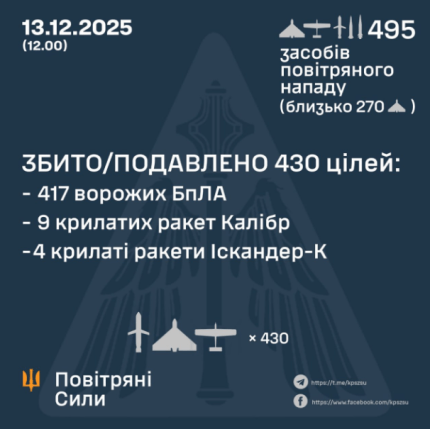

During the night of December 12-13, the Russian occupiers carried out a new massive combined strike on critical infrastructure facilities in Ukraine using strike UAVs, air-, sea- and ground-based missiles. Air defense forces were able to neutralize 430 enemy targets.
Points of attention
- The Defense Forces of Ukraine repelled the air attack utilizing aviation, anti-aircraft missile troops, electronic warfare, and unmanned systems units.
- The consequences of the Russian attack on Ukraine are still unfolding, with ongoing efforts to assess the damage and ensure the safety of the region.
Air battle between Russia and Ukraine — what are the consequences?
This time, the enemy targeted peaceful Ukrainian cities and villages:
465 attack UAVs of the Shahed and Gerbera types (drones of other types) from the directions of Kursk, Orel, Millerovo, Shatalovo, Primorsko-Akhtarsk — the Russian Federation, Chauda, Gvardiyske — the Autonomous Republic of Crimea (about 270 of them are "Shaheeds");
4 Kh-47M2 Kinzhal aeroballistic missiles (launch areas — Tula, Tambov regions — Russian Federation);
5 Iskander-M/KN-23 ballistic missiles (launch area — TOT AR Crimea);
5 Iskander-K cruise missiles (launch area — Kursk Region, Russian Federation);
16 Kalibr cruise missiles (launch areas — the Black and Caspian Seas).
The air attack was repelled by aviation, anti-aircraft missile troops, electronic warfare and unmanned systems units, and mobile fire groups of the Defense Forces of Ukraine.
According to preliminary data, as of 12:00, air defenses shot down/suppressed 430 air targets:
417 enemy Shahed, Gerbera type UAVs (other types of UAVs);
4 Iskander-K cruise missiles;
9 Caliber cruise missiles.