

The Economist analyzed Americans' attitude towards the activities of new President Donald Trump and concluded that not everything is as rosy as the country's leader assures.
Points of attention
- President Trump's approval rating in the US is plummeting due to Americans' dissatisfaction with his economic management.
- Young and Latino voters are notably disapproving of Trump, potentially leading to a loss of support from new voters who sought improvement in economic policies.
- The upcoming 2026 midterm elections will play a crucial role in determining the control of Congress and support for Trump, highlighting the importance of successful economic initiatives.
Trump's approval rating in the US is falling
In November 2024, Trump won the popular vote for the first time in three attempts by a margin of 1.5 points.
The mandate was huge,” he told Time.
It was actually the smallest margin since 2000, but it was an improvement on Trump's two previous election losses, by 2.1 points in 2016 and 4.5 points in 2020.
Trump sees his reelection as a testament to the MAGA movement and a mandate for radical and swift action, the publication notes. But three months into his term, there are signs that his popularity is eroding. His approval rating has fallen 14 points since he took office, more significantly than the five-point drop he has suffered so far in his first term.
In a YouGov/The Economist poll, Americans give Trump a net approval rating of minus seven percentage points on his handling of the economy, compared to positive ratings at this point during his first term.
Nearly one in five Trump voters in 2024 said they disapprove of his handling of inflation and prices, while 12% disapprove of his handling of jobs and the economy.
Similarly, in early April, data from a University of Michigan consumer survey showed that Republicans are less optimistic about the economy than at any time during Mr. Trump’s first term, except for December 2020, after he lost re-election.
Trump’s declining approval ratings are no mystery. Presidents have few levers to improve the economy in the short term. But after his inauguration, Trump seemed intent on finding them as quickly as possible.
Then came the new tariffs. Within two weeks, Trump had unveiled a stunning barrage of tariffs on nearly all of America’s trading partners.
But Trump's base of voters remains enthusiastic about him. More than 92% of Republicans who voted for him in November still view him favorably.
But his reelection was secured by swing voters and rarefied voters, many of whom were disappointed with the economy under Joe Biden. These pocket voters are more diverse than the traditional Republican base (Trump has made impressive gains among young voters and Latinos, for example) and are not hardline conservatives.
According to the Cooperative Election Study, 84% of voters who supported Mr. Trump in both 2020 and 2024 were white, 74% identified as conservative, and 72% were over 45.
The new voters he attracted in 2024 were different: 65% were white, only 42% said they were conservative, and only 41% were over 45. If Trump fails to deliver the economic boom he promised during the campaign, these voters could easily turn against him.
There are already signs of this. Among Latino respondents, Trump's net approval rating is minus 37 percentage points, and among those under 30, it is minus 25.
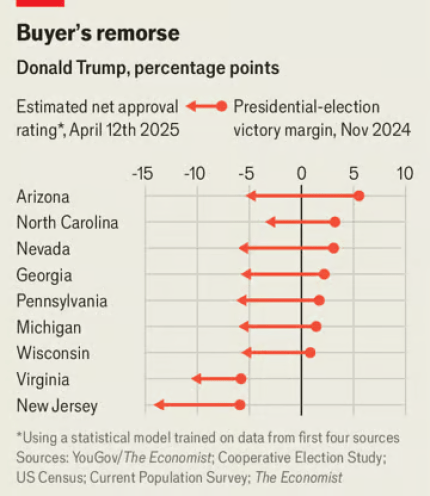
Trump has a net negative approval rating in all six states where he defeated Joe Biden in the November presidential election (Arizona, Nevada, Georgia, Pennsylvania, Michigan, and Wisconsin).
The biggest test will be the 2026 midterm elections, which will determine control of Congress and with it the fate of Trump's agenda. During his first term, Republicans lost 42 seats in the House of Representatives in 2018, and Democrats took control.


