
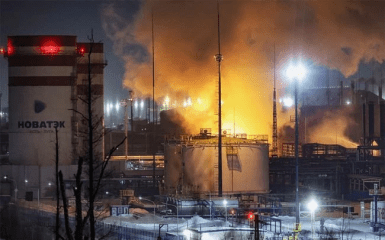
The fuel crisis in Russia, which began after Ukrainian drone attacks on oil refineries, has spread to 20 regions and some Russian-occupied territories of Ukraine.
Points of attention
- The fuel crisis in Russia, triggered by Ukrainian drone attacks on refineries, has impacted 20 regions and some territories in Ukraine.
- The shortages have caused the closure of independent gas stations and a surge in fuel prices, prompting the government to take action to regulate fuel transportation and activate reserve capacity.
- Disruptions in the supply of gasoline have led to record-high prices, with a significant loss in oil refining capacity and downtime of major refineries.
Drone attacks caused a fuel crisis in Russia: what is known
It is noted that at the end of August, a gasoline shortage was observed in Transbaikalia, Primorye, the Kuriles, and the temporarily occupied Crimea; in September, it was encountered in the Ryazan, Nizhny Novgorod, Saratov, Samara, Ulyanovsk, Penza, Rostov, and Astrakhan regions, as well as in Kalmykia and Tatarstan.
In addition, according to the Independent Fuel Union (IFU), supply disruptions are being recorded in the Amur, Magadan, and Sakhalin regions, the Khabarovsk Territory, Yakutia, the Jewish Autonomous Region, and Chukotka.
According to NPS President Pavel Bazhenov, disruptions in the supply of 92- and 95-octane gasoline have already led to the closure of a number of independent gas stations in the regions. Ekaterina Savkina, a member of the Russian Fuel Union, said that "a number of gas stations have not been able to receive shipments from oil refineries for several weeks."
The refinery shutdown led to a rise in stock prices for gasoline. Since the beginning of the year, they have jumped by 40-50%, and in August they broke historical records — 72.6 thousand rubles per ton of AI-92 and 82.2 thousand rubles per ton of AI-95. According to the St. Petersburg International Commodity Exchange, on September 9, AI-92 was trading at 71.8 thousand rubles per ton, and AI-95 — at 79 thousand rubles.
The Russian government has instructed oil companies to activate reserve capacity, adjust scheduled plant maintenance schedules, and manually regulate rail fuel transportation. It has also extended a ban on fuel exports for two months to stabilize the situation.
In total, as a result of Ukrainian drone attacks on refineries in August, Russia lost 17% of its oil refining capacity, or 1.1 million barrels per day.
A number of large plants completely stopped production — Novokuibyshevsk Refinery, Saratov, Volgograd and Syzran. The total downtime of refinery capacities in August reached 6.4 million tons, which was a historical record. In September, the Ryazan Refinery, which provides about 5% of all oil refining in the country, partially stopped its work.


