
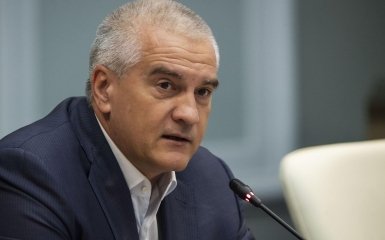
The Center of National Resistance (CNR) draws attention to the fact that the Russian occupiers from the so-called "State Committee for Water Management and Land Reclamation of Crimea" have actually recognized a serious problem with the water supply of Eastern Crimea. At present, they have no plan to solve this problem.
Points of attention
- CNR draws attention to the lack of a real plan of action and the reliance on inadequate water sources in Crimea.
- The impending collapse of water supply in Crimea may lead to a large-scale crisis, signaling the urgent need for intervention.
A large-scale water crisis is brewing in Crimea
According to the latest data, the situation in occupied Alushta is close to catastrophic.
It is in this part of the peninsula that the water reserves in the reservoirs will only last for the next 3 months.
What is important to understand is that for the last 3 weeks, the city has been operating on hourly water supply schedules, and the pressure in the system has been reduced to a minimum.
Recent events have led to a wave of panic among occupation officials.
In Simferopol, they currently cannot agree on who to blame for the impending collapse — the leadership of the “state committee” or Aksenov’s “government.”
The most interesting thing is that Putin's protege in Crimea himself lashed out with accusations against the Russian authorities, in particular the Russian Ministry of Defense.
According to Aksyonov, the defense ministry is massively withdrawing water for military facilities and training grounds.
Rumors are circulating in the occupiers’ political circles that Moscow is considering another “staff rotation” in the Crimean administration if the problem is not resolved by the end of the year. At the same time, officials from Alushta admit that there is no real plan of action: water supply depends only on rainfall and “internal reserves,” which are catastrophically lacking.
What is also important to understand is that in some areas of Alushta, people collect water from technical sources, and utility workers deliver water in tankers.
The water in them is not suitable for drinking, but there is no other option at the moment.
There is a high probability that Crimea will soon face a new large-scale water crisis — for the first time in the last 5 years.


