
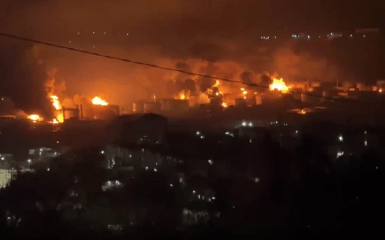
April 2026 was another month for the Ukrainian Defense Forces in a systematic campaign of deep strikes on Russia's military and economic infrastructure. Deep Strike weapons hit targets from temporarily occupied Crimea to Perm, Ufa, Orsk, and Chelyabinsk - that is, the Urals, which was historically considered the deep rear of the Russian Federation.
Points of attention
- The Ukrainian Defense Forces conducted a series of deep strikes across Russia in April 2026, targeting key military and economic infrastructure.
- At least 14 Russian refineries and terminals were hit, resulting in significant damage and financial losses for Russia's oil industry.
“Bavovna” in April 2026: 14 Russian refineries and terminals
Since the beginning of the year, the Russian Federation has lost at least $7 billion directly from Ukrainian attacks on the Russian oil industry and refining, the Ministry of Defense recalled.
In April, the Defense Forces struck at least 14 such facilities — from refineries in the Volga and Ural regions to port terminals in the Baltic and Black Seas.
Thus, a fire broke out at the Bashneft-Novoil refinery in Ufa (Bashkortostan). The plant was confirmed to have been damaged and a subsequent fire broke out. The strike range was about 1,400 kilometers from the border.
As a result of the strike on the Lukoil-Nizhnegorodnefteorgsintez refinery, a large-scale fire broke out at a distance of 800 km. The AVT-6 and AVT-1 primary oil processing units were damaged, as well as the 19/6 unit, which is involved in the production of petroleum bitumen. The AVT-2 technological unit and the LCH-24-7 diesel fuel hydrotreating unit were put out of action.
Three strikes were made on the Tuapse Refinery (Tuapse, Krasnodar Krai) at a distance of 1,500 km. The refinery was hit on April 16, 20, and 28 — the highest frequency of all targets during the month.
To destroy the Novokuybyshevsk refinery, the Defense Forces launched a strike with a range of about 1,000 km. Explosions rang out at the strategic enterprise with a capacity of 8.8 million tons per year, and then a fire broke out.
The Syzransky refinery (900 km away) was hit as part of a coordinated, massive attack. A fire broke out at the facility. This refinery is directly involved in supplying the Russian Armed Forces.
The strike at the Yaroslavsky refinery (750 km away) caused a fire. Damage to the vacuum distillation unit of oil has been confirmed.
After hitting the Orsknefteorgsintez refinery in Orsk, Orenburg region (distance 1,500 km), a fire broke out.
The strike on the Lukoil-Permnefteorgsintez refinery in Perm at a distance of 1,500 km was carried out by drones of the SBU's Alpha Special Operations Center.
Russia's key oil hubs, which provide both export revenues to the budget and directly meet the needs of the troops, were under attack.
The following port terminals and transport infrastructure were hit:
Port of Primorsk, Leningrad Region (850 km) — confirmed fire and damage to three RVSP-20000 tanks with a total volume of 60,000 cubic meters;
Ust-Luga Oil terminal, Leningrad region (900 km) — confirmed damage to three Transneft-Baltika tanks;
oil terminal "RPK-Vysotsk Lukoil-2", Leningrad region (950 km) — confirmed fire;
Tikhoretsk oil pumping station (Krasnodar Territory, 300 km) — confirmed fire;
Sheskharis oil terminal (Novorossiysk, 420 km) — a large-scale fire at a key Black Sea oil transshipment hub.
In turn, oil depots in Feodosia, Gvardiyskoye and oil pumping stations in Crimea and the Krasnodar Territory were hit as elements of the tactical supply of fuel and lubricants to Russian groups.
On April 10, the Defense Forces struck oil production infrastructure on the high seas for the first time.
The ice-resistant stationary platforms LSP-2 at the Graifer field and LSP-1 at the Korchagin field were damaged. The facilities are located about 1,000 kilometers from the line of combat contact.
On April 29, a unit of the Ukrainian Navy struck the sanctioned ship MARQUISE in the Black Sea, 210 kilometers from Tuapse. Two kamikaze naval drones (MBEKs) hit the stern in the area of the propeller-steering group and engine room.
Defense forces struck two factories in Russia in April:
On April 1, the Strela plant (Suzemka, Bryansk region) was hit. It produces components for cruise missiles and has fulfilled more than 120 state contracts for the needs of the Russian defense industry. It is under sanctions from Ukraine.
On April 19, the Ukrainian Navy launched a precision strike with Neptune missiles on the production building of the Atlant Aero plant in Taganrog.
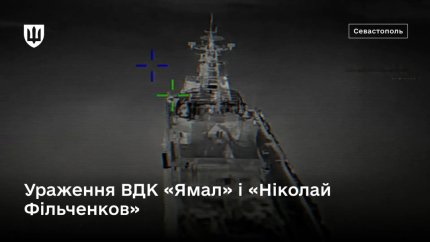
April was marked by successive strikes on the Russian Black Sea Fleet's naval fleet in Sevastopol and the Kerch Strait:
On April 19, the "Ghost" unit of the Main Intelligence Directorate of the Ministry of Defense disabled two large landing ships in the Sevastopol Bay.
The Yamal Project 775 (built in 1988, displacement 500 tons, estimated cost over $80 million) and the Nikolay Filchenkov Project 1171 (built in 1975, displacement 1,000 tons, cost over $70 million) are key means of amphibious landing and supply for Russian forces in Crimea. Both ships are out of service. Total damage exceeds $150 million.
Strikes on the same ships were also carried out on April 20 and 26 by SBU forces.
On April 5, two strike UAVs hit the Project 11356P frigate "Burevestnik" — a carrier of Caliber cruise missiles. The extent of the damage was being clarified.
On April 26, as part of Operation Alpha, the SBU simultaneously struck a radio reconnaissance ship, a training center of the Black Sea Fleet, and the radio reconnaissance headquarters of the air defense forces.
MiG-31s at the Belbek airfield (a potential carrier of the hypersonic Dagger) and the technical and operational part of the airfield were also hit.
On April 22, damage to the conning tower of an FSB Border Guard ship in Sevastopol was confirmed.
On April 30, the Ukrainian Navy destroyed the FSB patrol boat "Sobol" and the anti-sabotage boat "Grachonok" in the Kerch Strait area. The enemy suffered irreparable and sanitary losses.
On April 25, at the Shagol airfield in the Chelyabinsk region of the Russian Federation, the Forces of Unmanned Systems struck two Su-57 fighters, one Su-34 fighter-bomber, and another aircraft of an unidentified modification. This was one of the most distant operations of Ukrainian Deep Strike assets — the targets were located at a distance of about 1,700 km from the state border of Ukraine.


