
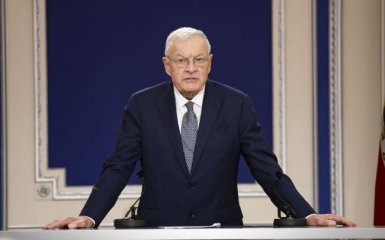
Russia will not give up control over the occupied territories of Ukraine, but legally they do not belong to Moscow. This creates a complex situation that will require further negotiations, believes US President Donald Trump's special envoy for Ukraine Keith Kellogg.
Points of attention
- Keith Kellogg's statement highlights the complexity of the situation in the Russian-occupied territories of Ukraine and the necessity for further negotiations.
- The distinction between de facto and legal control over the territories will play a crucial role in determining future political solutions.
- Kellogg emphasizes the importance of understanding the positions of both Ukraine and Russia in order to find a compromise that partially satisfies both parties.
Kellogg pondered the legal status of TOT Ukraine
He noted that the Russian Federation actually controls the Luhansk region, but only partially controls Donetsk, Zaporizhia, and Kherson. This in turn raises questions.
The question arises: what will the situation look like in the future? What are the real territorial achievements?

Keith Kellogg
Trump's special envoy for Ukraine
The special envoy emphasized that in any scenario of the end of the war, it is important to distinguish between de facto and legal control. Russia holds the occupied territories and does not intend to leave them, but from a legal point of view, these lands remain Ukrainian.
And here you need to distinguish between de facto and de jure. De facto means that they have physically occupied the territory and are not going to leave it. But de jure you cannot say that you have completely annexed it. The international community does not recognize this territory as part of Russia. These are the difficult discussions that still need to be held.
Kellogg explained that, in his opinion, in order to find a political solution, it is necessary to understand the positions of both sides. Then, a compromise must be found that will at least partially satisfy both Ukraine and the Russian Federation. At the same time, he added that neither side will get everything it wants.
I think we need to get what you could call a technical brief. What do the Ukrainians want? What do the Russians want? Then we need to bring those positions together and find an option that maybe satisfies both sides. But of course, neither side will get everything they want.


