
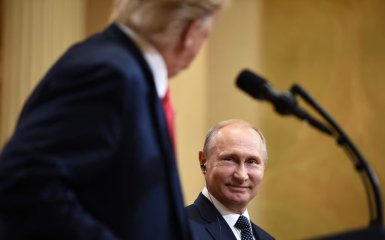
US President Donald Trump has already done what illegitimate Russian President Vladimir Putin wanted 29 times during his second term.
Points of attention
- Trump fulfilled 29 of Putin's wishes in his first month in office, including initiating direct negotiations with Russia and showing support for far-right parties in Europe.
- The increased cooperation and investment agreements with Russia under Trump could have negative consequences for international security and stability.
- Many of Trump's actions, such as praising Putin, criticizing Europe's migration policy, and cutting funding for democratic NGOs, align with Putin's interests.
Putin's wish-fulfiller: what Trump did for friendship with Russia in a month
The publication provided a brief overview of 29 such cases in the first month of Trump's return to power.
Phone call with Putin. Nearly three years after Russia's full-scale invasion of Ukraine, Trump decided it was time to restore direct contact between the US president and Putin, who is under US and EU sanctions and has an arrest warrant for crimes against humanity and genocide from the International Criminal Court. The 90-minute call took place on February 12.
Praised Putin: "I want to thank President Putin for his time and effort on this call," Trump said.
Said he "would love" to see Russia back in the G7: "I would love to see them back. I think it was a mistake to kick them out," Trump told reporters the day after his call with Putin.
Maintaining Russian control over much of Ukrainian territory: US Defense Secretary Pete Hegseth called Ukraine's goal of returning all territories occupied by Russia since 2014 "unrealistic."
He stated that the Russians hold "all the cards" in peace talks "because they have captured a lot of territory."
Agreeing with Putin's demand for no NATO missions in Ukraine: Hegseth said that any troops from NATO countries serving in Ukraine would not fall under Article 5 of the alliance, which states that an attack on one NATO member is an attack on all.
He ruled out the deployment of US troops to Ukraine.
He said that Europe, which has relied on American protection since 1945, must "take care of itself."
Holding unconditional talks with Russia in Saudi Arabia.
Failure to involve Ukrainian representatives in these negotiations.
Refusal to admit European representatives to the negotiations.
He stated that Ukrainian President Volodymyr Zelenskyy "started this war."
He allegedly called Zelensky “incompetent.” (Later, the NSDC Central Directorate denied that Trump had allegedly stated Volodymyr Zelensky’s “incompetence”: in fact, his statement referred to former US President Joe Biden — ed.)
He hardly criticized Putin at all.
He said that Putin can be "trusted and he wants peace."
He called for elections in Ukraine.
He cut funding for international observers and cyber agencies.
He called Zelensky a "dictator."
Preparation of investment agreements with Russia: joint projects in the Arctic were discussed.
Ending funding for democratic NGOs: The Kremlin has long complained that US-funded NGOs are an “intelligence front” fomenting “color revolutions” in former Soviet republics.
He began the fight against Vokism (a socio-political ideology that emphasizes the fight against injustice, discrimination, and inequality in various aspects of social life).
Criticized Europe for its migration policy.
US Vice President JD Vance supported the victory of far-right pro-Russian candidate Calin Georgescu in Romania, which was annulled by the Constitutional Court.
Vance criticized the German government for its stance of distancing itself from the far-right.
Support for the far-right Alternative for Germany party in the German elections.
Elon Musk supports the right-wing populist party Reform UK in the United Kingdom.
The US opposed the wording "Russian aggression" in the draft G7 statement on Ukraine.
Trump's victory in the US presidential election: The Kremlin is certainly pleased that Trump defeated Kamala Harris.
Trump has hinted that he would be willing to change the U.S. Constitution to allow him to stay in office for a third term. Putin has already done this in Russia.


