

Hungarian Prime Minister Viktor Orban has begun publicly interfering in German politics, lambasting the country's authorities over a recent official decision by the Federal Office for the Protection of the Constitution to classify the Alternative for Germany party as far-right.
Points of attention
- US Vice President J.D. Vance and Secretary of State Marco Rubio publicly accusing Germany of 'tyranny' adds another layer of complexity to the situation.
- The ordeal underscores the delicate balance of political alliances and power dynamics within the European Union amidst growing tensions.
Orban expressed his claims to the German authorities
The Hungarian leader decided not to mince words to express his dissatisfaction with the German government's decision.
What the hell is going on in Germany? Orban fumed in a short post.
Against the backdrop of recent events, he decided to support AfD leader Alice Weidel, writing that she "can count" on Hungary's support.
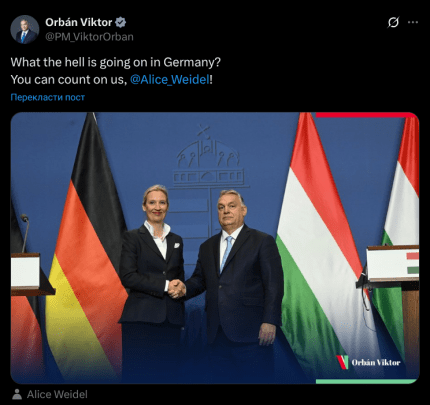
Weidel expressed her gratitude to Orban in X "for his words of support" and promised that "despite the obstacles, AfD will continue on its path for the good of our country."
What is important to understand is that the Alternative for Germany (AfD) is a pro-Russian political force, so the decision of the German authorities is quite logical.
For example, the leader of the Social Democratic Party of Germany, Lars Klingbeil, has warned that the future government, in which he will become Vice Chancellor, will consider banning the party.
However, this development does not suit the team of US President Donald Trump.
Thus, on May 3, US Vice President J.D. Vance and Secretary of State Marco Rubio publicly accused Germany of "tyranny."


